Search for stock alerts and you will find endless screenshots of huge winners. What you will rarely find is the alert that lost money the next day. Before you pay for any service, it helps to know what real evidence looks like.
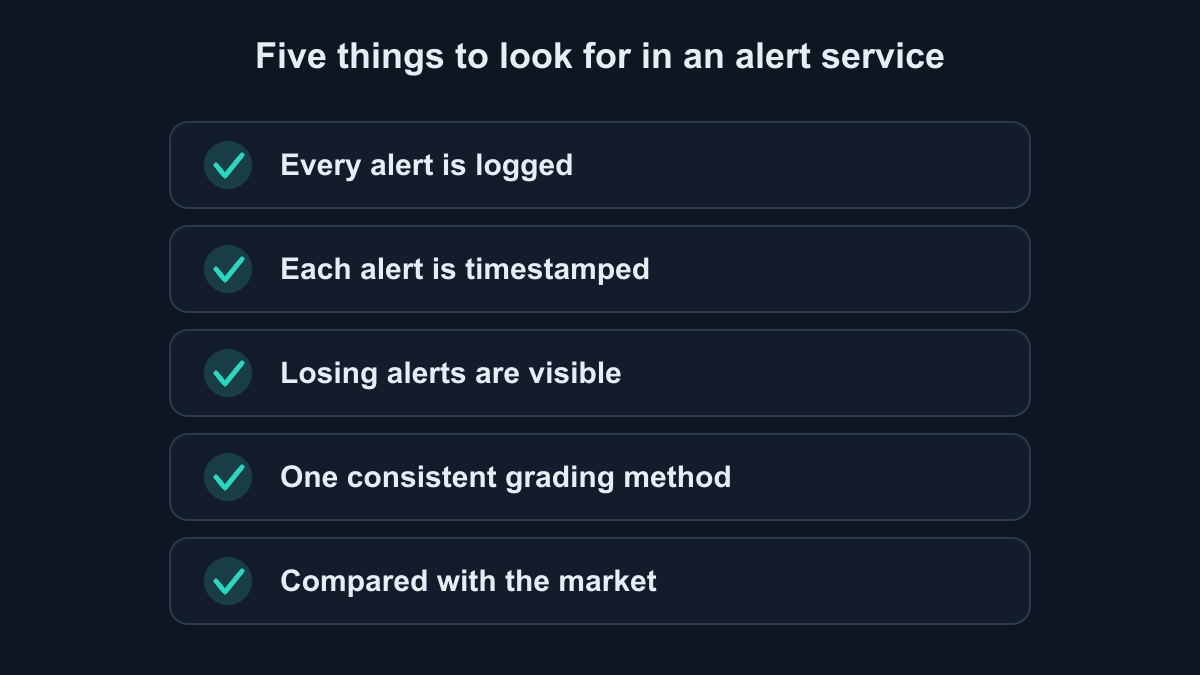
1. Is every alert logged?
The most common trick is selection. Send out 100 alerts and advertise the best five. Ask whether you can see all of them. A complete record is less flattering, which is why so few services offer one.
We have logged every alert since April 2026: over 362,000 alerts across more than 3,900 tickers.
2. Are alerts timestamped when they fire?
A result is only meaningful if you know when the alert appeared. An entry price chosen later can make any trade look good. Look for a clear time on each alert, and be careful with results that only appear at the end of the day.
3. Are the losers visible?
Every real trading approach has losing trades, and often a lot of them. A service with no visible losers is either hiding them or has not been around long enough. Bad weeks are useful, because they show how an alert behaves when conditions turn against it.
4. Is everything graded the same way?
Grading rules quietly decide how good a record looks. Counting the highest price reached after an alert sounds fair, but nobody sells at the exact top. Look for a consistent, published approach applied to every alert. We have over 190,000 graded results produced this way.
5. How does it compare with the market?
If the whole market rose 3% that week, a 3% gain is not skill. A useful record gives you context, such as how alerts did next to a broad index over the same period.
Warning signs to walk away from
- Promises of guaranteed returns or a fixed win rate.
- Only screenshots, with no searchable record.
- Pressure to join immediately or lose your spot.
- No mention of risk, or a track record that begins last month.
- A win rate shown with no information on how big the losses are.
Why win rate alone can mislead you
A strategy can win 90% of the time and still lose money if a single loss wipes out many gains. Another can win well under half the time and do fine, because winners are much larger than losers. Always look at the size of wins and losses together, along with how long trades were held.
Apply this checklist to us
We built our public Alert Results page so you can do exactly that. Each alert also explains in general terms what kind of trade it is for, so you can decide if it fits your style. See plans and pricing when you are ready to compare. Our 7-day trial lets you try it before your first payment.
Sources and further reading
- Investor.gov (SEC): Artificial Intelligence and Investment Fraud
- Investor.gov (SEC): Pump and Dump Schemes
This article is educational and is not investment advice.