Anyone can claim their system works. A better approach is to run it in real market conditions, with no real money at risk, and write down everything that happens. That is what paper trading is for, and it is how we test our own trading AI.
Our paper account so far
We started our AI paper account with $2,000 in simulated money on October 19, 2026. As of the close on November 9 it stood at $2,214.85, after 30 completed trades. That is a very short record, and we expect it to have losing stretches. Our learning system chooses and places the trades automatically, with no one picking them by hand, throughout the extended trading day on weekdays. We will soon publish the results daily, wins and losses alike.
Paper results use simulated money, may not reflect real-world fills, and do not predict future returns. This is not investment advice.
What is AI paper trading?
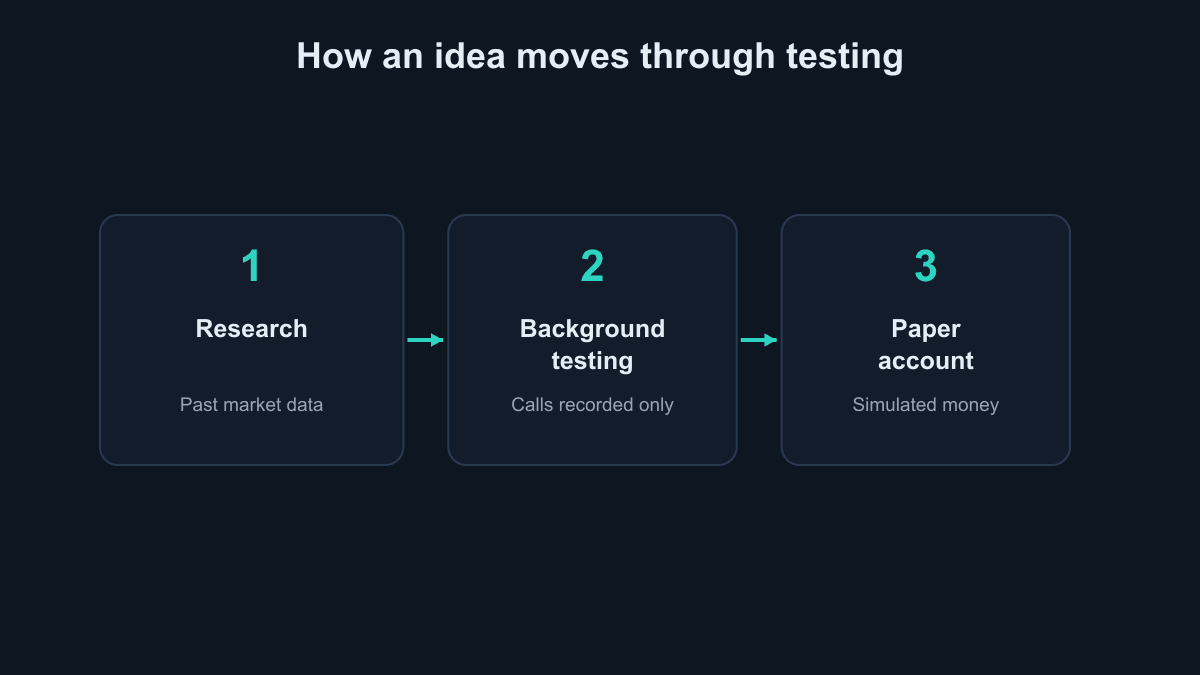
Paper trading means placing simulated orders against live market prices with pretend money. For an AI system, it answers practical questions that a backtest cannot. Does it act on time? Does it handle a stop properly? What happens on a chaotic morning?
What paper trading can prove
- The process works. Signals, orders, stops and exits happen as designed.
- Risk rules hold up. You can see whether position limits and daily stops do their job.
- Behavior on unseen days. Every session is new data the model did not train on.
What paper trading cannot prove
- Real fills. Simulated orders can fill at prices a real order might not get, especially in options and thinly traded stocks.
- Real emotions. Pretend money does not make anyone nervous.
- Future results. A good stretch can come from favorable conditions.
How to read any paper track record
Whether it is ours or someone else's, a few questions separate a useful record from a sales pitch:
- When did it start, and with how much? A record without a start date and a starting balance cannot be checked.
- How many trades are behind it? Thirty trades can be luck. Hundreds, across different market conditions, say more.
- Are losing trades shown? A list of winners is marketing, not a track record.
- Was the account ever reset or topped up? Ours never is. It has to be traded up from where it stands.
How we use it
We test our trading logic on a dedicated paper account with fixed risk limits on every trade and a cap on open positions. We also review what happened on the trades it skipped, because a rule that avoids winners has a cost too. Good days and bad days both go in the record.
You can already review our graded alerts on the Alert Results page, read how we use walk-forward testing, and learn more about what the platform does today.
Sources and further reading
- Investor.gov (SEC): Artificial Intelligence and Investment Fraud
- Bailey, Borwein, López de Prado and Zhu, The Probability of Backtest Overfitting (SSRN)
This article is educational and is not investment advice.