A neural network is a program that learns from examples instead of following rules someone wrote by hand. Show it enough situations and what happened next, and it slowly adjusts itself to get better at telling them apart. That idea sounds perfect for the stock market. In practice, it is one of the hardest places to make machine learning work.
Here is how the training works, in plain English, and how we approach it at My Own Stock Guru.
What a neural network actually does
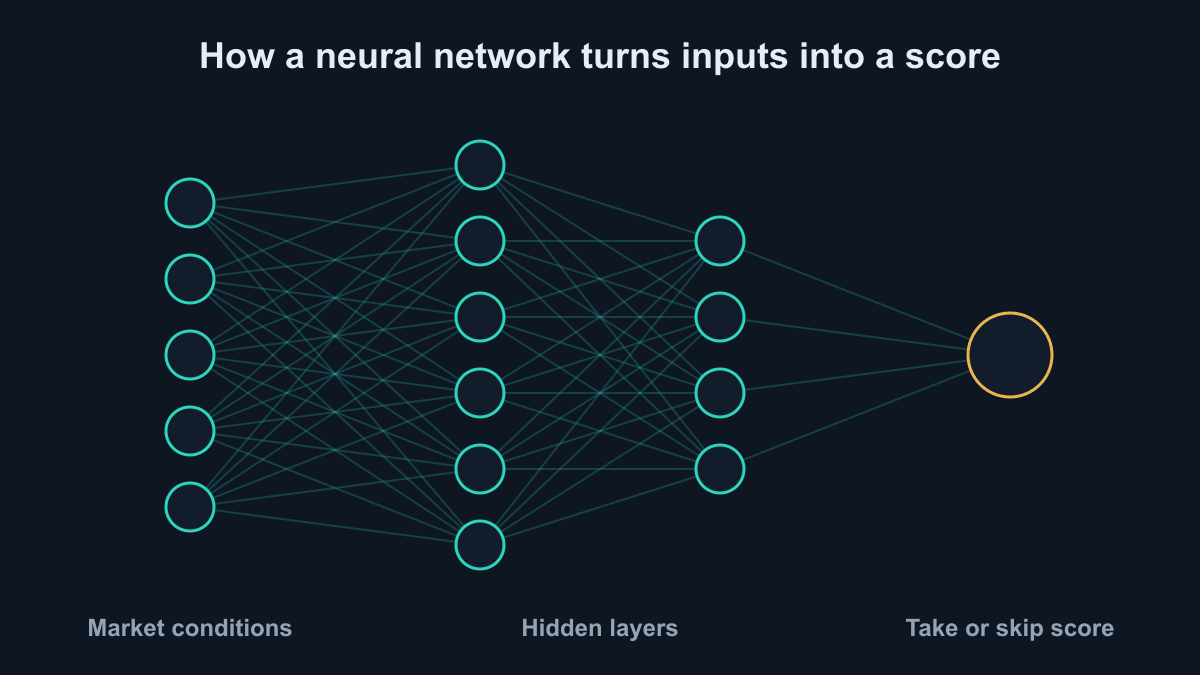
Think of it as three stages:
- Inputs. Numbers describing a moment in the market, known at that moment.
- Hidden layers. Connected steps that combine those numbers into patterns no single number shows.
- Output. A score, such as how likely a setup is to be worth taking.
Training means showing the network thousands of past examples. Each time it is wrong, the connections responsible get nudged a little. After many passes, the network has tuned itself to the examples.
Why the stock market is so difficult to learn
A photo of a cat is still a cat next year. Markets are different in three ways:
- The signal is faint. Most price movement is noise, so a model can easily memorize randomness.
- The rules change. What worked in a calm market can fail in a volatile one.
- Everyone is competing. When an edge becomes obvious, traders act on it and it shrinks.
This is why a neural network with an impressive backtest means very little by itself. The real question is whether it holds up on data it has never seen.
How we train our models
We will not share the recipe, because what goes into our models is the part that took years of work. We can share the principles we hold ourselves to:
- Real history, at scale. Our research draws on about two years of market history and over 15 million market snapshots.
- Only what was known at the time. A model never gets to peek at anything that happened after the moment it is judging.
- A simple opponent. Every neural network has to beat a much simpler model. If the simple one does just as well, the complex one is not used.
- Each alert learns on its own. Different kinds of alerts behave differently, so they are not forced into one model.
- Failure is a normal result. Many candidate models do not pass, and we throw those away.
What AI can and cannot do for traders
A trained model is good at sorting. It can look at a long list of possible setups and help decide which ones deserve attention first. It cannot see the future, and it will be wrong often. Any service that says otherwise is selling something other than the truth.
The goal is not a machine that is always right. It is a process that gets a little less wrong, and proves it on days it never saw.
See the results for yourself
We log our alerts and grade them, and you can check the record on our public Alert Results page. To see what members use day to day, visit the features overview.
Sources and further reading
- Gu, Kelly and Xiu, Empirical Asset Pricing via Machine Learning (NBER working paper)
- Bailey, Borwein, López de Prado and Zhu, The Probability of Backtest Overfitting (SSRN)
- Investor.gov (SEC): Artificial Intelligence and Investment Fraud
This article is educational and is not investment advice.