Most portfolio protection quietly costs money. If you keep puts on your holdings and just leave them there, you pay premium month after month while the market drifts higher, and much of that protection expires worthless. Hedging works better when you understand the choices and what each one costs.
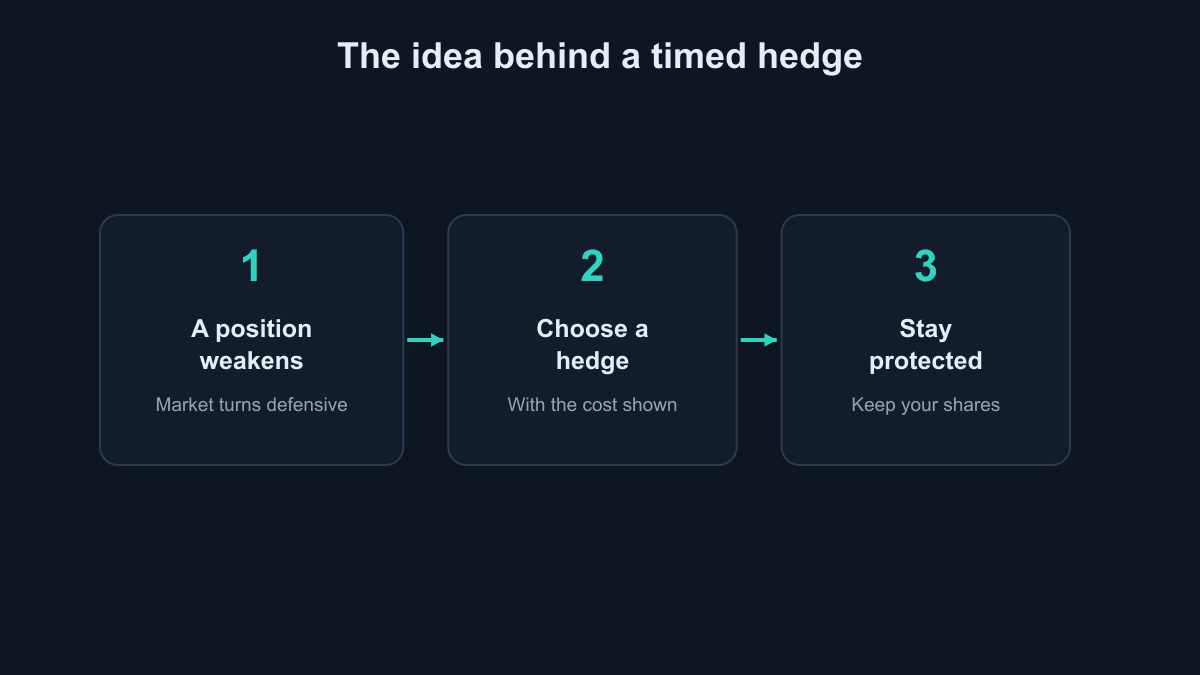
Three common ways to hedge a stock position
- Protective put: buy a put on shares you own. It sets a floor below the strike, and the cost is the premium.
- Put spread: buy a put and sell a lower one. It costs less, but protection stops at the lower strike.
- Collar: buy a put and pay for it by selling a call. It is cheap or free to open, but it caps your upside.
A simple example
Suppose you own 100 shares of a stock you bought at $50 and you are worried about the next two months. These numbers are hypothetical and only show how each choice behaves.
- A protective put with a $45 strike means that, below $45, further losses are covered until the put expires. Your worst case is the drop to $45 plus what you paid for the put.
- A $45/$40 put spread costs less, but it only covers the move from $45 down to $40. Below $40 you are unprotected again.
- A collar that adds a short $57 call can bring the cost near zero, but if the stock runs to $65 your gain stops at $57.
None of these is "best." The right one depends on how much you will pay, how far you can fall, and how much upside you will give up.
What makes a hedge expensive
Options cost more when implied volatility is high, which is usually after fear has already arrived. Buying protection in a panic often means paying the highest price. Time also matters, since every option loses value as expiration approaches.
Why timing matters
A hedge kept on forever behaves like an insurance bill that never stops. A hedge placed for a specific reason, with a specific end date, is a decision you can evaluate later. Before hedging, ask three questions:
- What am I protecting against, and over what period?
- How much of the loss am I willing to absorb myself?
- What will make me remove the hedge?
Selling the position, or simply making it smaller, is also a valid hedge and it is often the cheapest one.
Coming soon: Portfolio Hedge Monitor
We are building a tool that looks at the positions you hold and shows how a portfolio like yours could be hedged with stocks or options. Each example will lay out the cost, the new maximum loss and the payoff before and after, and it will also say when a dip may not need a hedge at all.
It is education, not investment advice. It shows what could be done, you make every decision, and it will never place a trade for you.
In the meantime, you can compare structures and see the payoff before you decide using the Strategy Builder described on our features page. New to options? Read our options basics guide.
Sources and further reading
This article is educational and is not investment advice.